

Replacements
September 14, 2025 - Operation Market Garden Eindhoven to Arnhem

Our Tour Today: We leave the hotel in Eindhoven and head out to visit the 101st Airborne locations from Operation Market Garden, including the Son (Zon) Bridge, Nuenen and Koevering. We have lunch at a famous hotel (Hotel Erica) that witnessed the events of Operation Market Garden, then continue to various Allied and Airborne locations further north, including the Waal River, Schoonderlogt Farm, the “Island”, and the Arnhem bridge (also known as the John Frost Bridge). See the section on Our Day below for actual photos and experiences.
In History: The primary source of this historical information is derived from articles on Wikipedia and many links go to that on-line resource.
Steve has written a really superb overview of Operation Market Garden, the high-risk strategy to try and find a way into Germany through the Netherlands (news flash - it didn’t work, mostly). I will do a little bit of history about that day for Easy Company. They were part of “Market”, the airborne troop drops in various locations in the Netherlands (101st Airborne, 82nd Airborne, British 1st Airborne).
Easy Company was pulled off the line in Normandy about 30 days after D-Day. By this time, 22 of its men had been killed in action, mostly in Stick 66, and another 43 had been wounded, for a 47% casualty rate. Winters' roster records that of the 139 men of Easy Company who left England on the night of June 5, just 69 enlisted men and five officers were left: Winters; his three platoon leaders Buck Compton, Harry Welsh, and Warren Roush; and Roush's assistant Francis L. O’Brien. The Company returned to Aldbourne to await further orders. A planned jump into France in August 1944 in the Alsace region was canceled when General Patton’s 3rd Army reached the battle zones before the jump could take place. Meanwhile, replacement troops were streaming in at Aldbourne to strengthen the forces of the battalions.
Finally, another jump was planned into Holland (the Netherlands) as part of Monty’s crazy Operation Market Garden scheme. On September 17, 1944, Easy Company landed on its designated drop zone in a daytime jump in the Sonse Forest, northwest of Son and marched down the road into Son behind the 2nd Battalion's other two companies. On reaching the Son Bridge, they were met by enemy fire while the bridge was destroyed by the Germans. After the Regiment's engineers constructed a makeshift crossing (a Bailey Bridge), Easy and the rest of the 506th moved out for Eindhoven.
After leaving Eindhoven, Easy Company was accompanied by six tanks of the British 11th Armoured Division as they tried to head further north. Their advance was halted by the elite 107th Panzer Brigade outside Nuenen and they were forced to retreat. Here is a description of the Battle of Nuenen from Historica:
The Battle of Nuenen was a skirmish fought between the Allied Powers and Nazi Germany on 20 September 1944 amid Operation Market Garden. The American 506th Infantry Regiment of the 101st Airborne Division and the British 15th/19th The King's Royal Hussars of the 11th Armored Division moved into the village of Nuenen, where they were ambushed by a half-track belonging to the German 107th Panzer Brigade. In the ensuing battle, a German tank destroyed two British tanks, and four American and three British soldiers were killed; only two Germans were killed. The Allied advance was halted by the German victory, and the Allies were forced to retreat to Tongelre. Easy Company would proceed to defend the towns of Veghel and Uden until XXX Corps infantry took up the task.
On the night of 19/20 September 1944, 78 German bombers attacked Eindhoven. The Allies had no anti-aircraft guns in the city, allowing the Germans to bomb Eindhoven without loss. General Matthew Ridgeway (82nd Airborne), who was in Eindhoven during the attack, wrote (as quoted on Wikipedia):
"Great fires were burning everywhere, ammo trucks were exploding, gasoline trucks were on fire, and debris from wrecked houses clogged the streets"
Elements of the 101st, based in and around the city, witnessed the attack and escaped loss, and some from the 506th helped the citizens in the town.
Easy Company later defended the towns of Veghel and Uden until the British XXX Corps arrived. The company finally came to “the island” north of Nijmegen (tomorrow’s write-up), joining forces with the 82nd Airborne.
In Movies and Television: “Replacements” was the fourth episode of Band of Brothers. It starts with the men relaxing in one of the pubs in Aldbourne playing darts and meeting replacements. This was not an easy process for those poor guys, except for Babe Heffron, who hits it off immediately with Wild Bill Guarnere because they were both from south Philly. A planned jump into France in August 1944 was canceled at the last minute. The recently promoted First Sergeant Carwood Lipton tells the men that a jump is now on for the Netherlands and Winters informs them of the plan for Operation Market Garden. The daylight jump is without incident and the episode skips the Son bridge story by having the paratroopers head directly to Eindhoven. The people in the town are ecstatic and Winter is offered help from the Dutch Resistance. British tanks arrive in town. If you look closely during the crowd scenes, the real Babe Heffron is sitting at a table. This is the only appearance in the series by an actual Easy Company member.
E Company leaves Eindhoven and is heading towards the town of Nuenen when they are attacked by an elite Panzer corps. A battle ensues with several casualties and the destruction of the British tanks; one of the Easy Company sergeants, Denver “Bull” Randleman (Michael Cudlitz) is separated from the retreating troops. He survives in a barn for the night, with some help from a farmer and the farmer’s daughter, and is brought back to the company the next day, but not before retrieving the dog tags from one of the replacements lying dead in a ditch (Private James Miller, played by James McAvoy). As the group moves away from Eindhoven, Winters comments on how he hates to retreat and Nixon replies that there is a first time for everything.
Our Day on September 14:
We arose early (again) to leave by 8:15 am on our day-long historical overview of the areas near Eindhoven, Nijmegen and Arnhem. We have not said much about our hotels on this trip, but I plan to write up my usual critiques of the trip after we return, including rankings of our hotels and miscellaneous experiences, so watch for that!
Our first stop was at a street corner in Nuenen, now a quiet suburb of Eindhoven. There are plaques there commemorating the battle that took place in this town after Eindhoven was liberated. In an interesting historical aside, Vincent Van Gogh lived and worked in Nuenen from 1883 to 1885. In the Band of Brothers episode “Replacements”, Private David Webster notes as they are approaching Nuenen that Van Gogh was born there and Private Cobb (a notorious smart Alec that nobody likes) replies “Yeah, so what?”. So Webster was wrong! Here is the Easy Company plaque and a memorial to the British tank unit at that street corner, a view looking towards the location of the main part of the battle in 1944 (it was mostly farmland and a few buildings) and our historical expert Edwin talking about the battle.


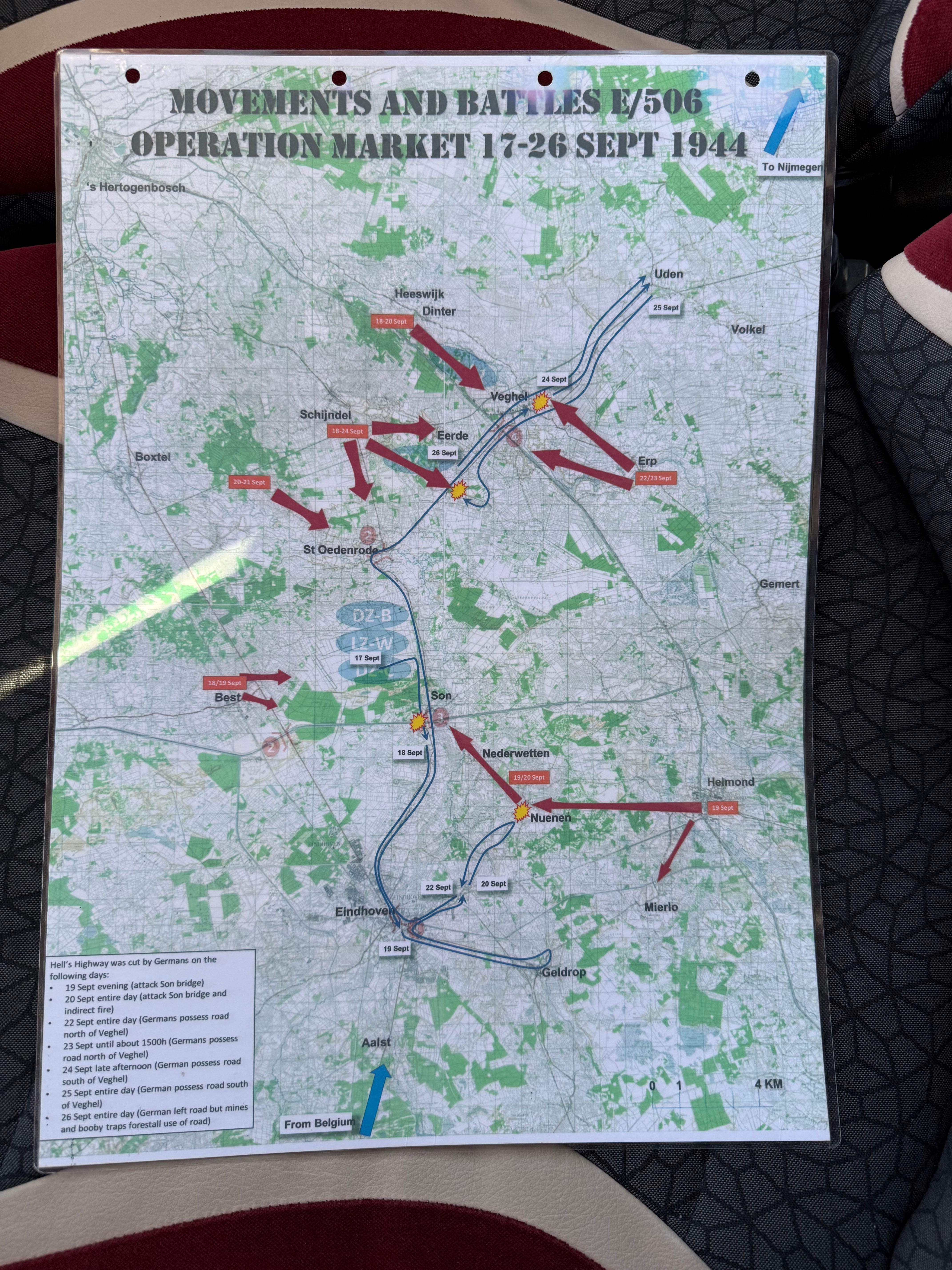
Our next stop was at the site of the Son Bridge over the Wilhelmina Canal. The Son Bridge was an objective of the 101st Airborne to keep the road intact for the advancing British tank units. As you might expect, there were many bridges in this low country dotted with canals and rivers. As they approached the bridge from the north (they jumped north of the canal in the Sonse Forest), the Germans detonated the bridge! The history above talks about the effort to install the Bailey Bridge. The Germans retook the bridge several times and closed it to the Allies. Here’s a map of the 101st Airborne actions and dates during Operation Market that we took a photo of that our historian had for reference:
Here are some photos of the canal as it looks today and the new Son bridge, which is a lift bridge as opposed to a swing bridge (the type that was destroyed); there is also a photo of a memorial to some British tank soldiers who were killed in action north of the Son Bridge:


My brain is already full! Fortunately, we stopped for a great buffet lunch at this point in the tour at the beautiful Hotel Erica in the countryside outside of Nijmegen. This hotel is in a group of historical hotels in the Fletcher group. Our host at the hotel was Marcel Hoogenboom, who is the grandson of a Dutch resistance fighter who died in 1945. Here is an excerpt of the story of this hotel and the Hoogenbooms, which is on the Liberation Route in Europe, from a story page they gave us at lunch:
After the fall of the Netherlands on 14th May 1940, German occupation was severe. Jews were required to register with the occupation government and mass arrests of Jews began in February, 1941. In response to these arrests, Dutch workers went on strike. When mass deportations of Dutch Jews began in 1942, Dutch resistance strengthened. LJA [Leendert Jakobus Adrianus]. Hoogenboom was one of the early resistors. He joined the resistance organization Groep Van Beest.
The group’s primary missions was transmitting coordinates of German positions to British bombers and spread[ing] illegal underground pamphlets and newspapers. The work was dangerous as the German occupation received assistance from the National Socialist Movement (NSB). This fascist organization gained a few seats in the Dutch Parliament in the 1930’s but became the sole political party in the Netherlands under the occupation.
Hoogenboom’s own neighbor was a member of the NSB and informed the Germans of the existence of a resistance member next door. Hoogenboom was arrested on 11th August 1942, becoming a Nacht und Nebel prisoner. These prisoners were arrested under cover of darkness and no information was ever transmitted about their fate. Hoogenboom was held in several concentration camps, the last one being Vaihingen. Hoogenboom was released in April 1945, but died in a hospital in Speyer, Germany before he could make it home. His son, also known as LJA carried on the legacy of his father as a volunteer in the building of the Liberation Museum near Middelburg.
The grandson (Marcel) promised his grandmother that he would keep the stories alive about LJA and the Dutch Resistance. He works with this chain of hotels in the Netherlands to bring his grandfather’s story to visiting groups, like ours today. Here are a couple of photos from our very moving experience at lunch today:


Our afternoon was action-packed! First, we had a stop by the Waal river (a branch of the Rhine) in Nijmegen to hear the story of the 82nd Airborne, 504th Regiment and their boat trips across that river to try and secure German and defeat German forces on the North side and secure two bridges from both ends. They suffered heavy losses, with 48 paratroopers killed. After the inability for the British 1st Airborne to retain the bridge at Arnhem, the enemy front advanced again as far south as Nijmegen. Here are some pictures from the stop at Nijmegen, including the new Nijmegen bridge:


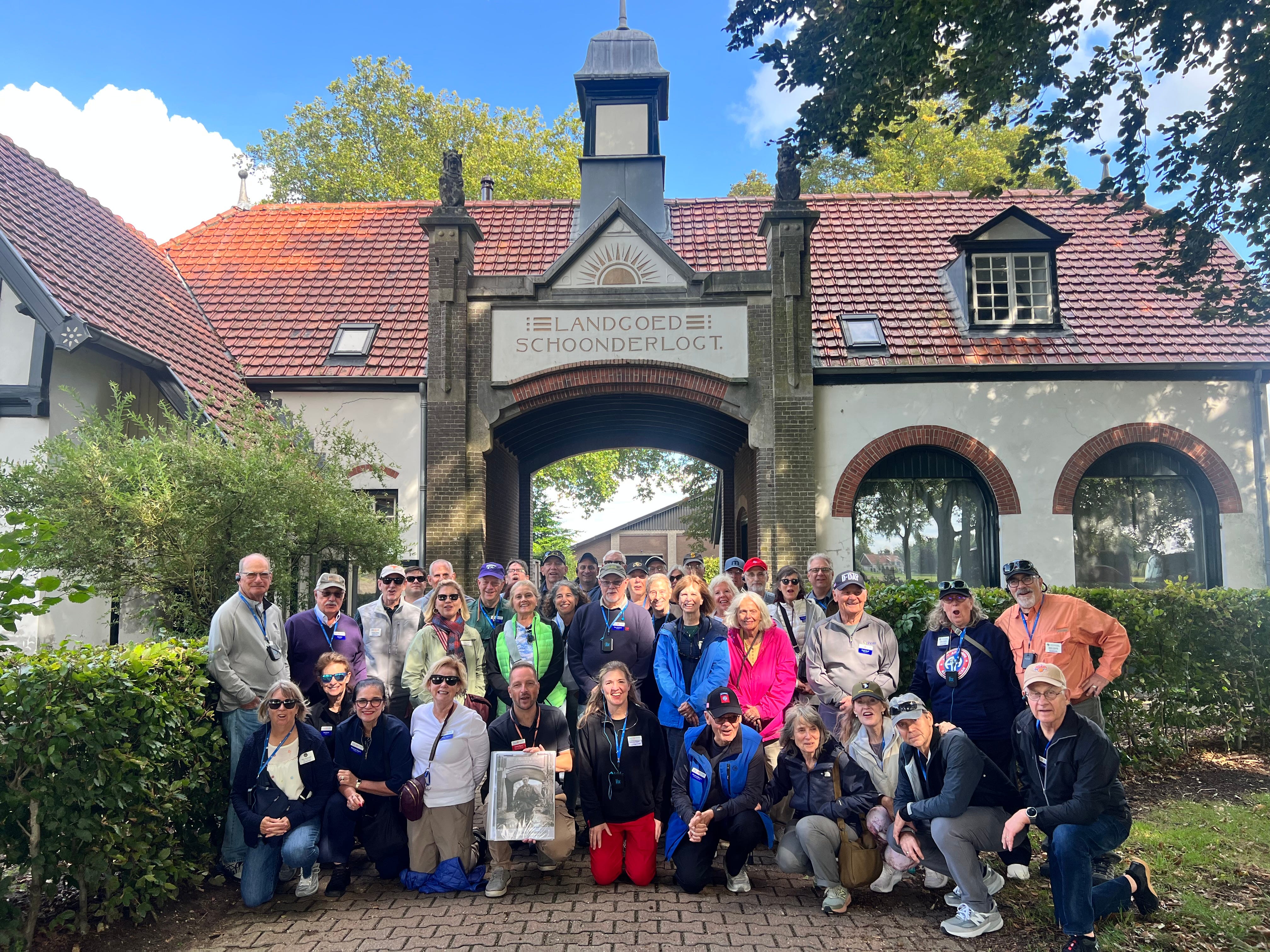
Next we had a stop at Schoonderlogt Farm (see top photo) and had a few minutes to view the memorial across the road:


Of course we had to visit the “Crossroads” on “the island” (the land between the branches of the Rhine river). This was the location for the famous battle between Easy Company and at least two companies of German soldiers, including many SS soldiers that happened on October 5, 1944 (see Steve’s write-up for tomorrow). Here are some photos from the “Crossroads” area on dikes running through the farmland (the re-creation of this area was extremely well-done in Band of Brothers):


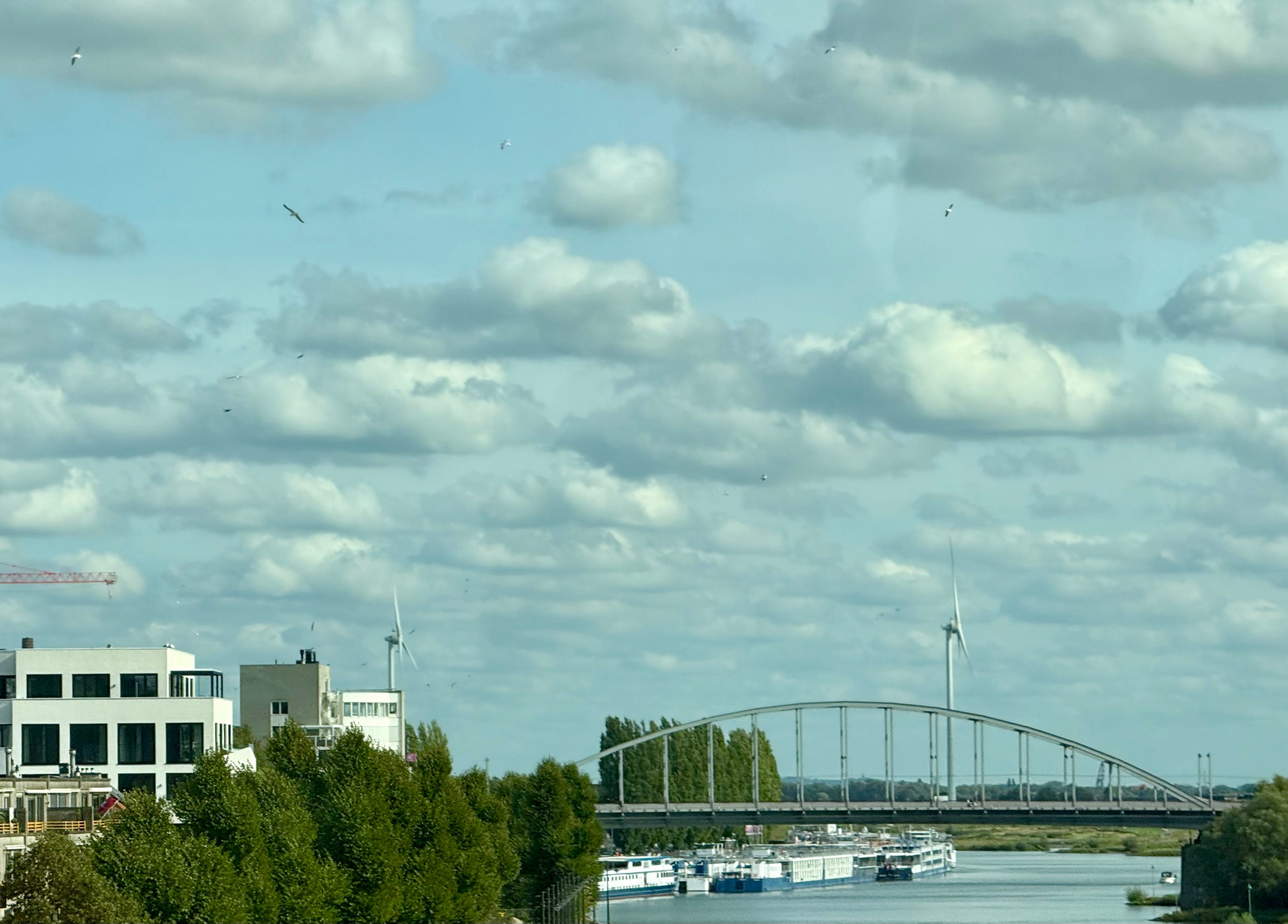
Unfortunately, we were unable to stop to view our final objective today, the Arnhem Bridge (since renamed the John Frost Bridge, after Major General John Dutton Frost, who led the 1st British Airborne troops in the failed attempt to take the bridge). We drove over the bridge and saw it from a distance (bad bus photo):
Ok, I’m done! Whew! You’re done, too, dear faithful readers (admit it), if you were able to slog your way through this mess. By the way, our historical guide today felt that Operation Market Garden was not really a failure! It did succeed in liberating the southern half of the Netherlands, saving millions of lives.
Tomorrow (9/15) we are taking the morning off (they have some optional morning tours), then will leave Eindhoven around 1:00 pm to visit the Netherlands American cemetery on our way to Clervaux, Luxembourg.